music_note


Kenya’s Biggest Budget Yet: CS John Mbadi Unveils Ksh 4.84 Trillion Spending Plan for 2026/2027
By Ronny Choge | June 12, 2026
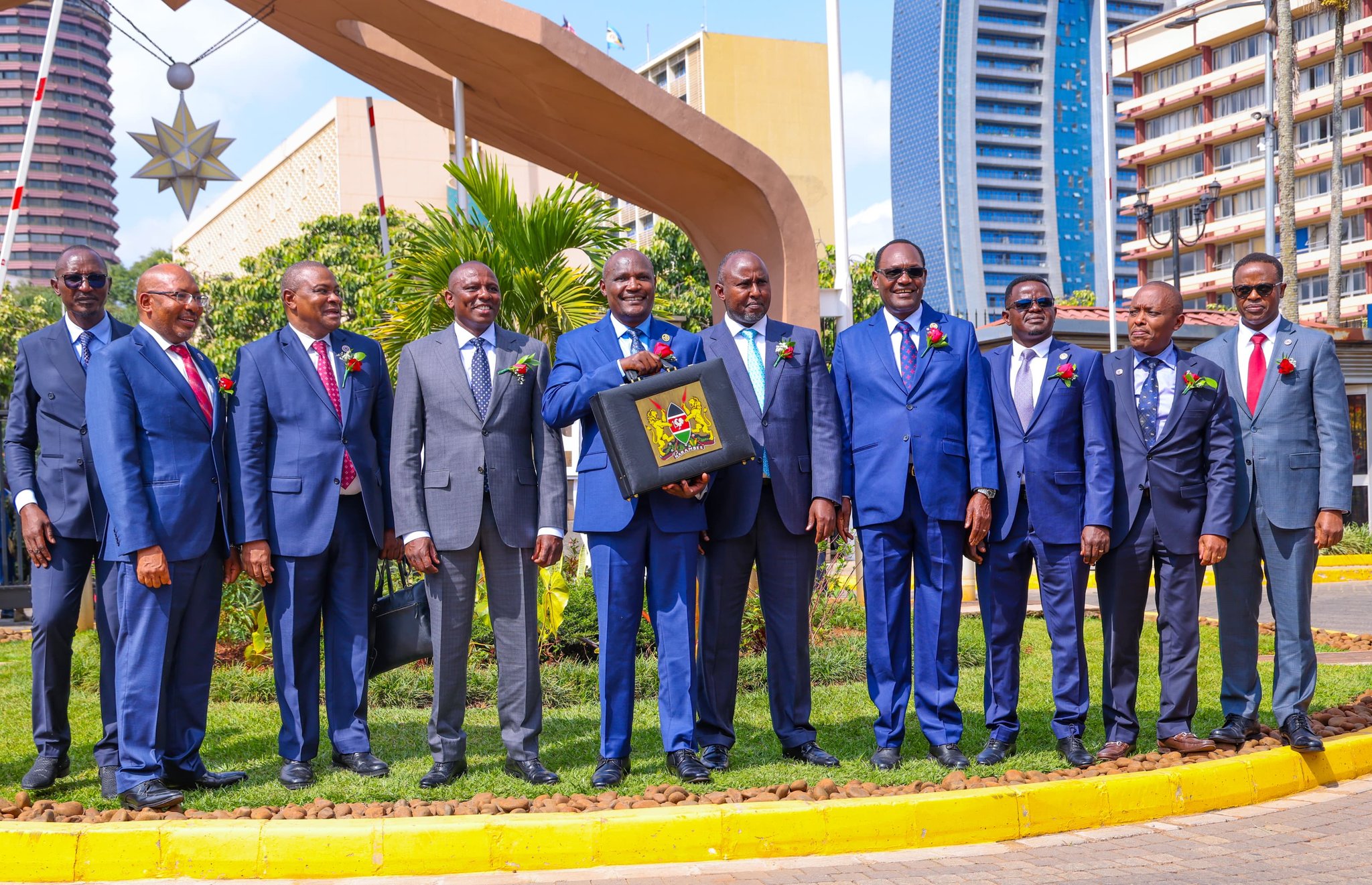
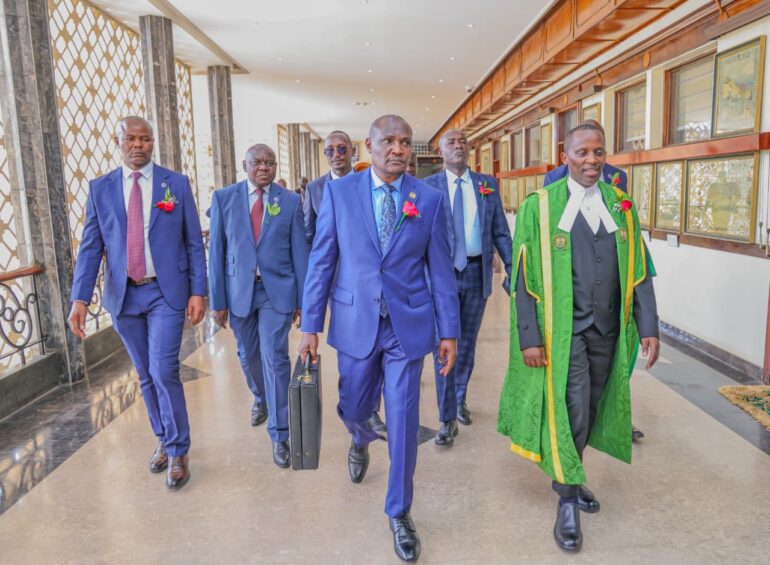
On the afternoon of Thursday, June 11, 2026, Treasury Cabinet Secretary John Mbadi walked into the National Assembly carrying the traditional black briefcase emblazoned with Kenya’s coat of arms and the word Harambee. What followed was a more than three-hour address that laid out the most ambitious spending plan in Kenya’s history— and instantly split the country down familiar political fault lines.
The Ksh 4.84 trillion budget for the 2026/27 financial year is not just a record-breaking figure. It is a political statement, an economic gamble, and a mirror held up to a country grappling simultaneously with soaring debt, a rising cost of living, and the distant but ever-present drumbeat of the 2027 general election.
A Budget Built on Public Voices — or So the Government Says
Mbadi was at pains to stress that this budget did not emerge from boardrooms and Treasury corridors alone. Over the past year, he personally criss-crossed the country leading public engagement forums in every region — sitting with youth groups, small-scale traders, mitumba operators, scrap metal dealers, journalists, faith leaders, manufacturers, and financial experts. His road show took him to Kilifi, Migori, Kakamega, Eldoret, Nakuru, Kiambu, Meru, Kajiado, Nairobi, and many stops in between.
The message from ordinary Kenyans, he said, was clear and consistent: reduce the tax burden on essential goods, stop the wastage of public money, and deal decisively with corruption. Mbadi told Parliament he had taken that feedback seriously, structuring the spending plan around the Bottom-Up Economic Transformation Agenda — prioritising private sector-led growth, job creation, and improved service delivery while maintaining fiscal discipline.
Whether those promises translate into lived reality remains to be seen. But the numbers, at least on paper, are striking.
Breaking Down the Numbers
The government plans to spend Ksh 3.54 trillion on recurrent expenditure and Ksh 749 billion on development projects. On the revenue side, the Kenya Revenue Authority is expected to collect Ksh 2.9 trillion from taxes, with a further Ksh 645 billion projected from public service fees. That still leaves a fiscal deficit exceeding Ksh 1.1 trillion — a gap the government intends to plug primarily through domestic borrowing, pushing total government debt further into record territory.
Critics have already seized on that deficit. But Treasury officials insist the spending plan is designed to accelerate growth, create jobs, and strengthen social infrastructure at a moment when Kenya cannot afford to stand still.
Education: The Crown Jewel
Education remains the single largest sector in the budget, receiving a proposed allocation of Ksh 784.5 billion. The figure reflects the government’s stated commitment to expanding access to quality learning from the ground up.
Among the headline announcements was the absorption of 20,000 intern teachers into permanent employment — a move that will ease a staffing crisis that has plagued public schools for years and deliver tangible relief to thousands of young educators who have languished on temporary contracts. The budget also included provisions for recruiting additional police officers to address shortfalls in public security.
Health: Hospitals, Housing, and the Ebola Question
The health sector received a proposed Ksh 177.2 billion, with one of the most notable announcements being the construction of a cancer treatment centre in Kisii — a facility that would serve residents across the wider Nyanza and Western regions who currently must travel to Nairobi or abroad for specialised cancer care.
Beyond bricks and mortar, Mbadi also set aside Ksh 9.4 billion to address the chronic problem of homelessness, targeting the settlement of vulnerable Kenyans without shelter. On the public health front, Mbadi moved to reassure Kenyans worried about the Ebola threat spreading from neighbouring countries, disclosing that Kenya has secured support from both the United States government and the World Bank to bolster disease surveillance and emergency preparedness systems.
Agriculture and the Blue Economy: Feeding the Nation, Unlocking the Waters
For Kenya’s farming and fishing communities, the budget brings a combined injection of Ksh 72.2 billion. Of that, Ksh 64 billion is earmarked for agricultural transformation programmes — aimed at boosting productivity, strengthening value chains, and building resilience among smallholder farmers who remain the backbone of the rural economy.
A further Ksh 8.2 billion goes toward the blue economy and fisheries sector, unlocking opportunities within Kenya’s marine and inland water resources. The allocation is part of a broader government strategy to reduce food insecurity, grow rural incomes, and position Kenya as a regional agro-processing hub.
Digital Procurement: Closing the Corruption Tap
One of the most consequential administrative announcements in the speech was the mandatory shift to digital procurement. Starting July 1, 2026, all government purchasing must be conducted through the Electronic Government Procurement system — ending the era of procurement conducted outside digital platforms, which has long been identified as a breeding ground for corruption and inflated contracts.
The end-to-end system, managed by the National Treasury, is designed to automate public sector purchasing, create an auditable trail for every shilling spent, and reduce the discretion that has historically allowed procurement fraud to thrive. Mbadi also announced plans to introduce a new Planning Bill in 2026 to close a longstanding gap in Kenya’s public finance architecture — one that has, by his own admission, weakened the link between government policy and budget implementation.
Youth, Small Businesses, and the Election-Year Subtext
Analysts have noted the unmistakeable electoral undertone running through the budget. With the 2027 general election on the horizon, President Ruto’s administration has structured a spending plan heavily weighted toward the youth and rural communities — the two demographics most likely to decide the next vote.
Mbadi’s speech was peppered with references to initiatives already benefiting young Kenyans and small businesses, alongside new measures in the pipeline. He also took a pointed swipe at the administration of former President Uhuru Kenyatta, questioning the pace at which certain development initiatives were rolled out during that era — a rhetorical move that drew applause from government-aligned MPs but sharp rebuttals from the opposition benches.
Framing the budget in soaring terms, Mbadi invoked the political vision of both President William Ruto and ODM leader Raila Odinga, describing the spending plan as a blueprint to steer Kenya from Canaan through Singapore — a fusion of the two political leaders’ most iconic rallying metaphors, and a signal that the broad-based government arrangement between the two former rivals remains the ideological scaffolding of this administration.
A Tough Budget for Tough Times
Mbadi did not pretend the moment was easy. He acknowledged openly that the 2026/27 budget is one of the most challenging in recent memory, shaped by a combination of external economic shocks, sluggish revenue collection, and rising inflation. The government has been forced into difficult trade-offs — balancing public expenditure, mounting debt obligations, and growing demand for essential services, all at once.
“The people of Kenya want assurance that their hard-earned taxes will translate into tangible improvements in their daily lives,” he told Parliament.
The Opposition Fires Back
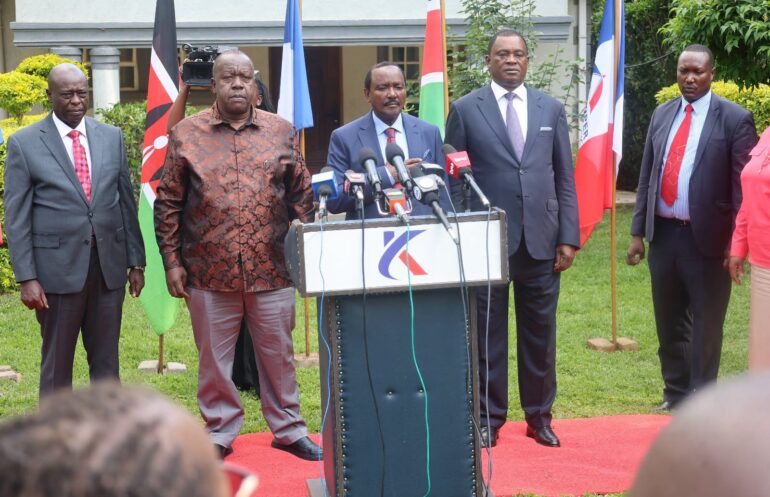
Even before Mbadi took the podium, the opposition had arrived with its own numbers and a sharply different narrative.
Under the banner of the United Alternative Government, opposition leaders gathered the day before the budget reading to unveil what they called the People’s Budget — a leaner, alternative fiscal plan totalling Ksh 4.3 trillion, cutting over Ksh 500 billion from the government’s proposals. The document was read by Wiper Party leader Kalonzo Musyoka, flanked by Democratic Change Party leader Rigathi Gachagua, Jubilee Deputy Party leader Fred Matiang’i, and former National Assembly Speaker Justin Muturi.
Their message was blunt: the Ruto government is borrowing recklessly, taxing remorselessly, and spending politically. They accused the administration of deepening the country’s debt crisis while ordinary Kenyans struggle to afford basic goods. Their alternative plan promised to reduce the cost of living, improve public services, cut reliance on borrowing, and drop proposed taxes on mobile money and mobile phones — measures they argued disproportionately punish low-income earners and small traders who rely on their phones for business and survival.
The opposition also took direct aim at the Social Health Authority, which they said has failed to deliver on its promise of accessible healthcare, and announced their opposition to any plans to privatise strategic state assets.
Inside Parliament, the dissent grew louder still. Opposition-aligned MPs dismissed the budget as a political document dressed up as a development plan. Former Budget and Appropriations Committee chair Ndindi Nyoro pointed to the swelling deficit as evidence of election-driven spending. “Every time before elections, we see an escalating deficit. The government is trying to prioritise political and campaign projects,” the Kiharu MP said, warning that the money was flowing into confidential votes and opaque allocations that serve political rather than public interest.
Another MP questioned the outsized share of the budget going to State House, Interior, Defence, and the National Intelligence Service, arguing that these allocations deliver little visible benefit to ordinary citizens.
Regional exclusion also surfaced as a grievance. Wajir North MP Ibrahim Abdi Saney, speaking shortly after the budget was read, accused the Treasury of once again sidelining Northern Kenya. “What are they producing? For me, so far, I’m not happy, and I can’t offer even a smile,” he said.
At the centre of the opposition’s wider campaign is the Finance Bill 2026 — the legislation through which the government plans to raise an additional Ksh 120 billion in revenue. The bill has become a rallying point for activists and opposition politicians who fear a repeat of the 2024 upheaval, when a previous Finance Bill triggered nationwide protests that saw Parliament briefly stormed. Opposition leaders are reportedly planning demonstrations in June to mark the anniversary of that moment, and have urged Kenyans to reject the Finance Bill outright.
Mbadi hit back hard. He accused the opposition of fabricating clauses in the Finance Bill that do not exist, calling their campaign to reject the bill wholesale a politically motivated exercise designed to mislead Kenyans. He maintained that the bill is intended to ease, not increase, the tax burden — and that after more than 17 public engagement forums across the country, the final document genuinely reflects what citizens asked for. On the prospect of street protests, he was unmoved: any demonstrations, he said, would be driven by political ambition, not genuine public grievance.
What Happens Next
The budget now moves to Parliament for debate, with MPs expected to scrutinise sector allocations, interrogate the deficit financing strategy, and weigh in on the Finance Bill 2026. The opposition has already signalled it will fight the bill clause by clause.
For ordinary Kenyans, the stakes could not be higher. The cost of unga, fuel, rent, school fees, and hospital bills will ultimately determine whether this budget is remembered as a turning point or a missed opportunity. And with 2027 looming, every political actor knows that the verdict belongs not to Parliament — but to the voter.

About Post Author