music_note


Afrophobia: Why South Africa’s Crisis Should Worry Kenya Too
By Ronny Choge | 6th July 2026
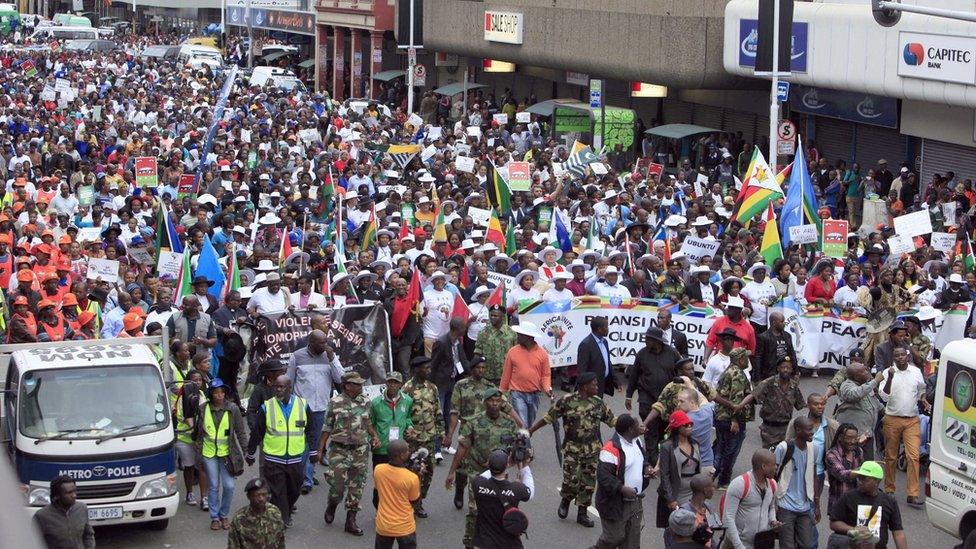
Across South Africa, a wave of anti-immigrant vigilantism — often described as “black-on-black xenophobia” or Afrophobia — has moved from scattered community anger into an organized, politically consequential force. Groups like Operation Dudula and the #PutSouthAfricaFirst movement didn’t emerge overnight; they grew steadily by tapping into years of unaddressed economic pain, and they now shape mainstream political conversation rather than sitting on its fringes. For Kenya, this is not a story to observe from a safe distance. The forces driving it — economic desperation, political convenience, and a fractured information environment — exist here too.
What’s Actually Driving Afrophobia in South Africa
Economic desperation and resource competition. South Africa’s unemployment rate sits near 33%, with youth unemployment considerably higher — among the worst in the world for a G20 economy. In that environment, competition for even informal, low-wage work becomes existential, and migrants who accept lower or unregulated wages are cast as the reason locals can’t find jobs, rather than a symptom of a labour market that isn’t creating enough of them. This resentment is sharpest in the township economy, where migrant entrepreneurs — many from Somalia, Ethiopia, and Zimbabwe — have built successful informal retail networks known as spaza shops. Local traders, often working with less capital and weaker supply chains, frequently accuse these businesses of undercutting them out of the market entirely. Layered on top of this is the visible strain on public services: overcrowded clinics, under-resourced schools, and long housing waitlists become flashpoints where undocumented migrants are blamed for scarcity that is, in reality, rooted in decades of underinvestment.
Political scapegoating and governance failure. Rather than confronting corruption, chronic load-shedding, and poor service delivery directly, several political actors have found it more expedient to redirect public anger toward foreign nationals — a pattern that intensifies predictably around election cycles. This scapegoating is reinforced by genuine, longstanding frustration with the Department of Home Affairs, whose porous borders and inconsistent enforcement have created a credibility vacuum. Movements like Operation Dudula step into that vacuum, using the state’s own failure as justification for extralegal actions — profiling, “citizen’s arrests,” and forced business closures — framed as public service rather than vigilantism.
Crime and safety prejudice. Grassroots movements have been particularly effective at linking undocumented migrants, as a category, to serious organized crime — drug syndicates, trafficking networks, and small-business robberies — regardless of individual guilt. This blanket criminalization gains traction specifically where trust in the South African Police Service has eroded; when communities believe the police are either corrupt or too slow to respond, vigilante groups position themselves as the only functional form of order, however violent or extrajudicial their methods.
Historical legacy and enforced isolation. Much of this hostility is rooted in apartheid-era structural isolation, which cut Black South Africans off from the rest of the continent for generations and produced a hyper-nationalist identity in which other Africans are viewed as distant, untrustworthy outsiders — a prejudice still carried in the derogatory term Makwerekwere. Compounding this, decades of institutionalized state violence, and the coercive tactics that were themselves necessary tools during the anti-apartheid liberation struggle, normalized community violence as an acceptable mechanism for enforcing order or resolving grievance — a norm that has outlived the struggle that created it.
Social media as an accelerant. None of this would move as fast without modern platforms. Social media is saturated with unverified footage, sensationalized headlines, and coordinated hashtags that inflate the number of foreign nationals in a given area or falsely attribute local crimes to them. This isn’t passive misinformation — it functions as an organizing tool, turning an online echo chamber into real-world marches and mob action within hours.
The Direct Hit on Kenya, Right Now
This is not a hypothetical risk for Kenya — it is an active, unfolding crisis with three concrete channels of impact:
Emergency repatriation. As South Africa has enforced strict immigration regularisation deadlines alongside rising vigilante activity, the Kenyan government has had to launch emergency operations, including Kenya Airways evacuation flights, to bring home citizens who fled targeted violence. These are not simply logistical operations — they are returning traumatised people who have lost their homes, income, and in many cases their entire adult lives built abroad, back into an economy that now has to absorb them with little warning or preparation.
Economic shockwaves and asset loss. Thousands of Kenyans operating small businesses, retail shops, and technical services in South Africa have had their premises looted or forcibly shut down. Beyond the personal devastation, this has a macro effect: it directly chokes remittance inflows, a channel that supports household consumption and, in aggregate, contributes meaningfully to Kenya’s foreign exchange position.
Diplomatic and regional strain. The crisis has produced visible friction at the continental level, with African diplomats boycotting state events in South Africa. This matters beyond symbolism — it tests the credibility of regional trade frameworks like the AfCFTA, which depend on the assumption that African states can coexist and cooperate economically even when domestic politics turn hostile to migrants.
Could Kenya Produce Its Own Version of This?
The uncomfortable answer is that the underlying conditions are already present domestically, not imported:
- Scapegoating risk: During periods of high inflation, heavy taxation, or political friction, Kenyan leaders have the same incentive structure South African politicians do — and the same regional migrant populations (Somali, Ethiopian, South Sudanese, and other East African traders and refugees) available to blame for job scarcity or rising rents.
- Township-style commercial rivalry: In dense trading hubs like Nairobi’s Eastleigh or downtown markets, friction between local and non-local traders over wholesale dominance already exists at a low simmer. Economic desperation is the variable that could escalate ordinary commercial rivalry into openly nationalist confrontation.
- Youth unemployment as raw material: Kenya’s youth underemployment and economic exclusion mirror the demographic conditions that made South African youth so mobilizable by vigilante networks — a large population with limited economic stake in the status quo is, structurally, easy to organize around a grievance.
- Border control populism: If public confidence in Kenya’s immigration and security institutions continues to erode, there is a real path toward grassroots groups conducting their own profiling or “roundups” of undocumented regional migrants, using the same justification Operation Dudula uses in South Africa: that the state has failed to act, so citizens must.
What Kenya and Africa Must Do — Before, Not After
Domestically, Kenya needs structural reform, not reactive crisis management:
- Formalize and support the informal sector through municipal training and inclusive banking policy that brings migrant and local traders into the same cooperative and business-association structures, removing the “us versus them” framing from everyday commercial competition.
- Strengthen enforcement of hate speech laws, with the NCIC actively tracking and prosecuting xenophobic or tribalistic content online before it escalates from digital rhetoric into street violence.
- Decouple security operations from nationality and ethnicity — blanket, high-profile crackdowns that publicly link specific migrant groups to crime build exactly the structural prejudice that later justifies vigilante action.
- Ensure that humanitarian and development funding in refugee-hosting areas like Garissa, Turkana, and Eastleigh visibly strengthens shared local infrastructure — clinics, schools, water access — so that host communities experience migration as adding capacity rather than draining it.
At the continental level, the African Union needs to treat this as a security issue, not a domestic embarrassment:
- Actively use the Continental Early Warning System to monitor hate speech, vigilante mobilization, and populist rhetoric across member states, flagging hotspots before they reach a breaking point.
- Attach real diplomatic and economic consequences — including trade privilege suspension or leadership sanctions — to states that tolerate or benefit politically from anti-immigrant violence.
- Push for ratification of the AfCFTA’s Protocol on Free Movement of Persons, since a trade area that moves goods freely while criminalizing the people who produce them is structurally incoherent.
- Have the African Commission on Human and Peoples’ Rights investigate and publicly name state actors who allow vigilante groups to operate as parallel, unaccountable policing structures.
Civil society and the private sector have a role too:
- Multinational and pan-African corporations should direct meaningful CSR investment into the township and informal economies most exposed to this tension, demonstrating in material terms that regional integration benefits ordinary people, not just capital.
- Education systems across the continent should teach modern African history and the shared economic logic of regional migration, actively working against decades of state-enforced isolationism that made this prejudice possible in the first place.
The Bottom Line
Afrophobia is not a uniquely South African pathology — it is what happens anywhere economic anxiety, political convenience, and an unregulated information environment are allowed to compound unchecked. For Kenya, the emergency repatriation flights are the visible symptom of a crisis that has already crossed the border economically and diplomatically. The real test is whether Kenya treats this as a warning to fix its own structural cracks now, or waits to manage its own version of the same crisis later.

About Post Author