music_note


Kenya at the G7: Ruto Takes Africa’s Voice to Évian
By Ronny Choge | June 18, 2026
A Seat at the World’s Most Exclusive Table
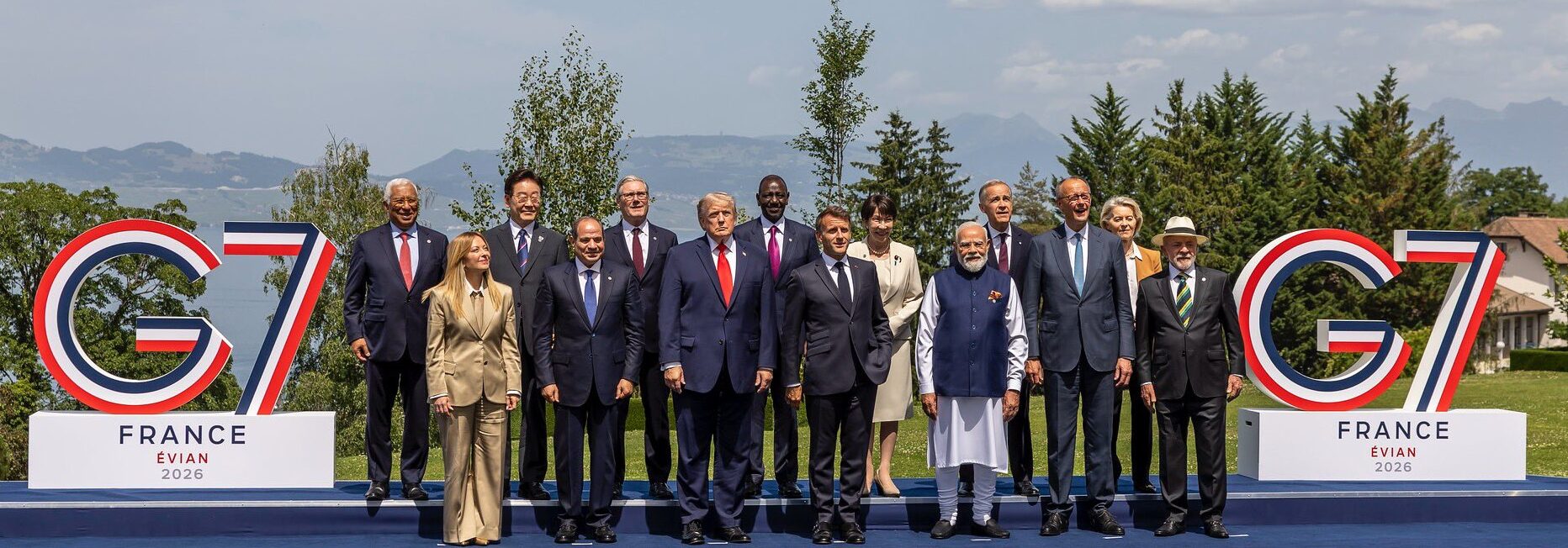
In a small Alpine town on the French shores of Lake Geneva, Kenya made history this week. The 52nd G7 Leaders’ Summit was held from June 15 to 17, 2026, in Évian-les-Bains, Haute-Savoie, France — and President William Ruto was in the room.
State House confirmed that President Ruto received a personal invitation from French President Emmanuel Macron, adding that the invite reflects Kenya’s growing influence in global affairs and its role in advancing the interests of Africa and the Global South on the international stage. Alongside the seven member states, France invited several guest countries, including Kenya, India, Brazil, Egypt and South Korea.
This was not a routine diplomatic courtesy. Ruto’s invitation to the summit reflects the growing recognition of Kenya’s strategic leadership role in global affairs and the confidence placed in his voice on matters concerning Africa and the Global South. In that capacity, the President articulated Africa’s unified position as concretised during the Africa Forward Summit held last month in Nairobi, which established a common continental agenda on economic transformation, financial reform, climate action and digital development.
President Ruto attending the summit represented part of Kenya’s growing diplomatic role on the global stage, where he was expected to represent Africans’ interests.
“Partner, Not Beggar”: Ruto’s Challenge to the World
From the moment he arrived in Évian, Ruto set a clear tone. This was not a visit to ask for handouts. It was a mission to reframe how the world sees Africa entirely.
Kenya’s President William Ruto revisited his familiar call for world leaders to see Africa as a partner, not a beggar, in renewed global engagement. He challenged the world to rethink its perception of African countries, saying the continent has vast potential and needs genuine support to flourish.
His words carried a sharpness that left little room for diplomatic ambiguity. “We must sort out the issue of access to concessional resources to unlock the potential of Africa. Africa continues to borrow from the international community at significantly high interest rates, even higher than comparable economies in the world,” he told G7 leaders.
He went further, addressing the mispricing of African economic risk head-on. “We must deal with a mispriced Africa,” he declared, arguing that international credit institutions systematically overestimate the risks of investing on the continent, locking African nations into punishingly expensive debt.
Upon arrival, the Kenyan leader stated that Africa would not shy away from articulating the injustices it has faced in the current formation of the United Nations, nor the subsequent challenges it has encountered with international financial institutions. He noted that the failure to reform bodies like the UN Security Council, the IMF and the World Bank continues to worsen Africa’s economic vulnerabilities — a structural problem, not a character flaw.
In the session on balanced global growth, Ruto said Africa would be central to the future of the world economy, noting that the continent hosts six of the world’s fastest-growing economies and is projected to account for nearly 40 percent of the global workforce by 2050. He urged international partners to support value addition within Africa, including mineral processing, industrial manufacturing, and job creation on the continent, warning that global growth strategies that ignore Africa would be incomplete.
“Africa is not going to be merely a consumer. Africa is going to write the rules and is going to be co-creators on how artificial intelligence drives the next industrial and global revolution,” Ruto told the assembled leaders.
And in what may be his most quotable moment at the summit: “Pay attention to Africa. The future of global growth will be shaped there,” he said.
The Financial Architecture Push — And a Historic Declaration
At the heart of Ruto’s mission in Évian was a call to fundamentally restructure how the global financial system treats developing nations. This was not a new crusade — debt reform has been a defining theme of his presidency — but at the G7, his advocacy produced a concrete and significant result.
He spoke hours before the G7 leaders endorsed a “declaration on mutually beneficial international partnerships”, a document that identifies debt reform as a priority. “We recognise the need to update the current international development system to ensure it fully meets the needs of future generations and current challenges,” said the document, which was also endorsed by invited guests Kenya and South Korea.
The declaration went further: “We will also continue our efforts to strengthen the global debt architecture, notably by calling for greater transparency in debt data and lending practices among all stakeholders.”
Kenya is set to benefit from G7-backed reforms in global finance, including guarantees, risk-sharing instruments, and improved debt restructuring frameworks, following the three days of high-level talks. Ruto said Kenya’s participation had helped advance key reforms aimed at lowering the cost of capital for developing countries and unlocking private investment flows into infrastructure, health, and financial systems.
Ruto also pointed to African-built solutions as part of the answer: “There are mechanisms that we can de-risk whatever that people think is a risk in Africa. There are African multilateral financial institutions that we are building, that can act as guarantor for us to access such resources.”
Ruto said the outcomes marked significant progress for Kenya and the continent in reshaping global financial systems, reducing investment risk perceptions, and strengthening Africa’s role in global governance reforms, including institutions such as the UN Security Council, IMF and World Bank.
Summing up the spirit of the engagement, he offered a vision of what true partnership should look like: “The partnership Africa seeks is one measured not by aid, but by what we build, invest in and achieve together.”
Courting the Tech Giants: Kenya’s AI Ambition
Beyond the formal summit sessions, the sidelines of Évian became a high-stakes technology boardroom, with Ruto conducting a remarkable series of meetings with the world’s most powerful technology executives.
On the sidelines of the summit, Ruto met global technology leaders, including executives from OpenAI, Anthropic, Google, Microsoft, Meta, Nvidia, Mistral AI, Cohere, Black Forest Labs, Synthesia, Sakana AI, Domyn, Sarvam AI and Kakao. These engagements were aimed at positioning Kenya as a leading innovation hub in Africa and expanding opportunities for youth through technology-driven job creation.
The AI dimension of Ruto’s pitch was strategic. Ruto outlined Africa’s position on the governance and deployment of emerging technologies and pushed for equitable access to AI tools, as well as increased investment in digital infrastructure, data centres and skills development to ensure the continent is not left behind in the rapidly evolving digital economy.
On artificial intelligence, Ruto highlighted Africa’s rapidly growing digital population and called for stronger protections for children online, including age-appropriate design, improved content moderation and safeguards against exploitation, with systems adapted to African languages and contexts such as Kiswahili and Sheng.
Bilateral meetings with several heads of state and government were also held to strengthen strategic partnerships and attract investment into key sectors of Kenya’s economy, focusing on manufacturing, renewable energy, infrastructure, agribusiness, housing, healthcare, digital services and value-added exports, while unlocking opportunities under the National Infrastructure Fund.
The Bigger Stage: Kenya’s Diplomatic Momentum
Ruto’s presence at the G7 did not happen in isolation. It was the culmination of an intense period of Kenyan diplomacy. From Brussels to Helsinki and finally Évian, France, Ruto’s June 2026 itinerary reflects Kenya’s increasingly aggressive foreign policy posture as Nairobi seeks greater influence in global affairs, expanded trade partnerships, climate financing, and new investment opportunities.
Representatives from Brazil, India, Kenya and South Korea also took part in sherpa meetings from January to June 2026, focused on the main issues submitted to the leaders. This meant Kenya was not simply a last-minute addition to the guest list — it was embedded in the summit’s preparatory process from the very beginning.
Kenya has recently positioned itself as a diplomatic bridge between Africa and Western powers. It has also strengthened cooperation with France on trade, development and climate discussions.
Prime Cabinet Secretary Musalia Mudavadi, who accompanied Ruto to France, had earlier articulated the significance of the platform: “France is taking over the G7 leadership, and President Ruto has been invited to attend. This gathering gives him legitimacy on behalf of the continent to be able to canvass certain positions,” Mudavadi said.
The Tightrope: Diplomatic Triumph Meets Domestic Discontent
Back home in Kenya, the reaction to the Évian trip was far more complicated.
Kenya’s participation at the G7 summit sees it walk a familiar tightrope between international opportunity and domestic political risk. Though Kenya has attended three G7 summits since 2017, its presence this year has been spotlighted by South Africa’s reported exclusion following US pressure.
The domestic criticism has been sustained and pointed. This trip came after a series of heavy criticism from the public, media, and opposition leaders regarding the frequency and high cost of Ruto’s trips during a difficult economic period for the country.
Former Deputy President Rigathi Gachagua was among the most vocal critics. Speaking at a United Alternative Government rally in Bungoma on June 14, 2026, Gachagua questioned the frequency of the President’s trips abroad, suggesting that too much time is being spent outside the country at the expense of domestic priorities.
The Controller of Budget, in its nine-month expenditure report covering July 2025 to March 2026, flagged continued high spending on foreign travel within the national government, giving critics concrete ammunition.
The challenge for his administration is proving that diplomacy produces measurable domestic benefits. Kenya’s economy remains under pressure from debt servicing, living costs and public expectations for jobs.
Major anti-government demonstrations in June 2024, which led Ruto to dissolve his cabinet, followed a prolonged inflation crisis and proposed new taxes — but also came just weeks after a state visit to the US which drew criticism for its cost. Recent protests — over a US-backed Ebola quarantine facility on Kenyan soil, and a transport shutdown over rising fuel prices — show how external conditions continue to affect domestic politics.
Ruto himself has repeatedly pushed back. Speaking during a fundraising event at SDA Kiserian Church in Kajiado County, the President said his extensive travel schedule is part of the responsibility entrusted to him by Kenyans when they elected him to office in 2022. “We have many people who ask why the President recently returned from abroad and then went straight to Marsabit, Kakamega and now Kajiado. That is the work I was elected to do as the Head of State.”
He has also directly rebuked characterisations of him as a serial tourist: “I was looking at one of the headlines in the newspaper that William Ruto is travelling again. I wish they knew the kind of schedule that I have. I have not come here as a tourist or to waste time; I have come to ensure we have achieved certain things. Just for the record, I am the chief diplomat of our country. People want to know what Kenya stands for,” he said.
Verdict: Significance Beyond the Photo Opportunity
Ruto’s time in Évian-les-Bains produced tangible outcomes — a signed G7 declaration on debt reform, high-level technology partnerships, bilateral investment pitches, and a clear statement of Africa’s position on AI governance. These are not nothing.
Ruto said Kenya’s participation reaffirmed its position as a leading African voice bridging continental priorities with global action.
But the true measure of success will be written not in French Alpine resort communiqués, but in Nairobi’s streets, in the borrowing costs facing ordinary Kenyan businesses, in the jobs that technology partnerships either create or fail to create. A purely symbolic Kenyan presence at the G7 would do little to alleviate these pressures. The summit’s headline focus on global economic imbalances, however, was a chance for Kenya to speak out on structural conditions that have constrained its domestic choices.
If Ruto can convert high-level meetings into investment, climate finance and trade access, the G7 appearance could strengthen Kenya’s claim to regional leadership. The architecture for that conversion has been built. The question of whether it translates into lived improvement for Kenyans remains open — and will determine whether Évian is remembered as a turning point or merely another summit on an already crowded diplomatic calendar
About Post Author