music_note


War’s End in Sight: U.S. and Iran Ink Preliminary Peace Deal — but Key Disputes Already Loom
Tuesday, June 16, 2026 | Washington | Tehran |8 min read
By Ronny Choge
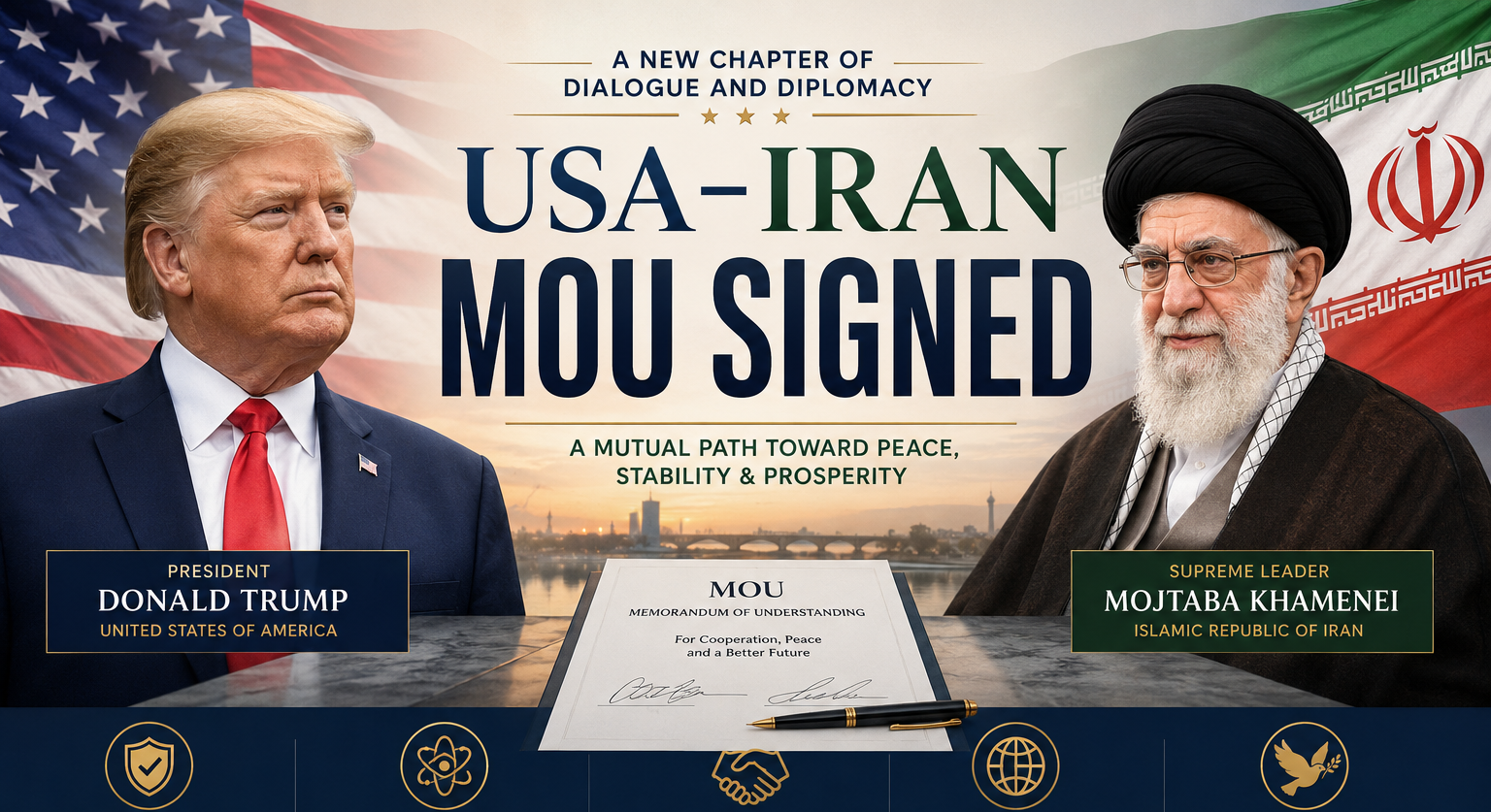
The United States and Iran have agreed to a preliminary Memorandum of Understanding that formally ends more than 100 days of war — a fragile but significant breakthrough brokered primarily by Pakistan and Qatar, and set to be signed in a formal ceremony in Geneva, Switzerland on Friday, June 19, 2026. Both sides signed the document electronically ahead of that ceremony. The agreement, informally called the “Islamabad Declaration” in recognition of Pakistan’s central mediating role, is described by officials as roughly a page and a half long. It is a broad framework rather than a comprehensive settlement, deliberately deferring the most contentious and complex issues to a structured 60-day technical negotiation period that follows its ratification.
U.S. President Donald Trump announced the deal on Truth Social in characteristically sweeping terms, declaring that “the Deal with the Islamic Republic of Iran is now complete.” He simultaneously authorized the toll-free reopening of the Strait of Hormuz — the strategically vital shipping lane that had been closed to commercial traffic — and ordered the immediate removal of the U.S. naval blockade on Iranian ports. Those two steps represent the most tangible and immediate deliverables in the preliminary framework, and their effect on global shipping markets is expected to be felt almost instantly.
“Ships of the World, start your engines.”— President Donald Trump, on Truth Social
Beyond those opening moves, the MOU establishes a mandate for an immediate and permanent cessation of hostilities on all fronts, and contains a renewed Iranian pledge never to acquire or manufacture nuclear weapons — a restatement of past commitments rather than a new concession. Crucially, the agreement also authorizes international nuclear inspectors to return to Iran, providing a baseline of oversight during the period before more comprehensive arrangements can be negotiated. Everything else — the permanent status of Iran’s nuclear program, the lifting of long-standing economic sanctions, the future U.S. military posture in the region, and the question of Lebanon — is explicitly set aside for the 60-day technical talks that the MOU unlocks. Any final agreement on nuclear matters will face mandatory review by the U.S. Congress before it can take effect.
A deal already contested before the ink is dry
Because the full text of the MOU has not yet been publicly released — the White House says it plans to publish the document within 24 to 48 hours of the electronic signing — both governments have moved quickly to fill the information vacuum with their own characterizations of what the deal says. The gaps between those characterizations are not minor. They go to the heart of how the 60-day talks will begin and what each side believes it is owed before those negotiations can even commence.
On the question of frozen assets and sanctions relief, the two sides are telling almost entirely different stories. Iranian state media, including the Mehr News Agency, have reported that Washington agreed to release between $24 billion and $25 billion in frozen Iranian assets and to suspend oil sanctions during the 60-day window as a confidence-building measure. The U.S. has flatly rejected this account. Vice President JD Vance and other White House officials have called the agreement a “pay for performance” deal, insisting that not a single dollar of sanctions relief or frozen funds will be authorized until Iran fulfills concrete commitments during the technical talks. Iran’s deputy foreign minister reinforced the Iranian position publicly, signaling that Tehran views the release of those funds as a prerequisite, not a reward — and that the next phase of talks could stall if Washington does not act first.
The dispute over Lebanon reveals a similar pattern of parallel narratives. Tehran has claimed that the framework guarantees a complete halt to military operations in Lebanon, effectively extending the agreement’s reach to cover the Israeli front. U.S. officials have offered a narrower reading, clarifying that the MOU carries no legal requirement for an Israeli withdrawal from southern Lebanon. That clarification has done little to resolve the tension, given that Israeli Prime Minister Benjamin Netanyahu has stated publicly that he and President Trump “do not see eye to eye” on the deal, and that Israeli forces intend to remain in their current positions regardless of what the document may or may not imply.
On the question of the American military footprint, Washington has been unambiguous: the U.S. troop presence and military posture in the region will remain entirely unchanged throughout the 60-day negotiation window. Reductions, if any, will only be considered as part of a final, fully verified peace treaty — not the preliminary framework that has just been signed.
How the deal came together
The MOU is the product of months of diplomatic effort that accelerated significantly in recent weeks. Pakistan played a decisive mediation role, with Pakistani Prime Minister Shehbaz Sharif declaring that the parties had reached a “final, agreed upon text” and that “peace has never been this close.” Qatar, which has long served as a channel of communication between Washington and Tehran, also played a key supporting role. The deal’s informal name — the Islamabad Declaration — is a direct acknowledgment of where the diplomatic breakthrough ultimately came together.
International reaction has been broadly welcoming. British Prime Minister Keir Starmer called the agreement “a hugely important step forward in ending the war, ensuring regional stability and re-opening the Strait of Hormuz,” and signaled that the UK stands ready to support the technical talks ahead. He also noted that Britain and France have been planning a defensive multilateral mission to assist with mine clearance in the Strait, if that assistance is ultimately needed. The most prominent dissent comes from Israel, whose prime minister’s public statements suggest a coalition partner that is, at best, unenthusiastic about the direction the deal is taking.
What happens next — and why it matters
The MOU is deliberately constructed to achieve a ceasefire now while pushing the most politically explosive questions into a bounded negotiation window. That architecture is both its strength and its vulnerability. The 60-day period is short enough to maintain momentum and prevent the process from drifting, but the agenda it must address — the permanent status of Iran’s nuclear program, the terms of comprehensive sanctions relief, the normalization of regional relationships — is vast. The conflicting public statements that have already emerged suggest that Washington and Tehran may be entering those talks with fundamentally different assumptions about what has already been agreed, which raises the possibility of early rupture rather than early progress.
For now, though, the guns have gone quiet, the Strait of Hormuz is reopening to the world’s shipping lanes, and a formal signing ceremony is scheduled for Friday in Geneva. Whether the silence holds and the process deepens into something durable depends almost entirely on what happens in the weeks ahead — in technical sessions, in congressional hearing rooms, and in the still-contested territory between what each side says it signed and what the document, once public, actually says.
About Post Author